

Light gray square, with a dark gray border on the sides.

Blog

Quantitative Assessment Of CAD Using CMR

February 3, 2022

Can quantitative assessment of coronary artery disease (CAD) open the door to greater reproducibility and diagnostic accuracy than qualitative methods?


In a recent review, researchers from the Cardiovascular Imaging Department at the Monzino Cardiology Centre in Milan, Italy, set out to explore the conduction of quantitative assessment of CAD, and its advantages over traditional, qualitative methods. The drawbacks of qualitative techniques were highlighted as limited sensitivity, low reproducibility, and the use of a binary approach to ischemia.


The review provided an overview of how myocardial perfusion can be used to assess CAD, as well as indications, challenges, and opportunities to improve patient management.


Superior performance of CMR?


The review highlighted the three “robust techniques” used for myocardial perfusion in clinical practice as single-photon emission CT (SPECT), positron emission tomography (PET), and cardiovascular magnetic resonance (CMR). Of the three techniques, CMR and PET had demonstrated superior diagnostic accuracy in most meta-analyses. A fourth method, CT perfusion, has emerged more recently, but the review pointed out that there is less literature containing evidence of this technique’s effectiveness than the first three methods.


The limitations of a qualitative approach


A comparison of CMR and SPECT in women with suspected CAD from the Clinical Evaluation of Magnetic Resonance Imaging in Coronary Heart Disease (CE-MARC) Trial found that qualitative assessment of ischemia with CMR had greater sensitivity than SPECT in both males and females. However, another study showed that adding semi-quantitative CMR to qualitative stress magnetic resonance myocardial perfusion could produce higher sensitivity, especially in left circumflex lesions detection.


There is more evidence to suggest that qualitative perfusion may be insufficient for future clinical practice. The Dan-NICAD study compared the diagnostic accuracy of myocardial perfusion (with visually-assessed SPECT and CMR) against invasive coronary angiography (ICA) with fractional flow reserve (FFR) in patients with suspected CAD by coronary computed tomography angiography (CCTA). It was found that the sensitivity of both CMR and SPECT, which were visually assessed, was low compared with FFR, questioning whether the diagnostic accuracy of qualitative perfusion is sufficient for future clinical needs.


Advantages of absolute quantification


The review identified the main advantages of the three quantification techniques – which are the dual-bolus protocol, pre-bolus technique, and single bolus with a dual sequence – as being “improved reproducibility and diagnostic accuracy”.


It highlighted the findings of a study by researchers from King’s College London which demonstrated that, compared with visual assessment, quantitative perfusion analysis techniques had a higher accuracy for correctly identifying the presence of coronary microvascular dysfunction. Research demonstrating that the capacity to detect functionally significant coronary stenosis is incrementally improved by the successive addition of coronary flow reserve, stress myocardial blood flow (MBF), and relative flow reserve to relative perfusion defect assessments was also presented, along with the CE-MARC trial’s establishment of CMR’s superior diagnostic accuracy over SPECT in CAD.


An insufficient level of training has been picked out as the main determinant of the diagnostic accuracy of visual assessment.


Using myocardial perfusion to assess CAD


The review’s authors stated that in their own experience, as a first-line test in symptomatic patients with a previous history of revascularisation, CMR offered higher cost-effectiveness compared to anatomical assessment with CCTA.

The Dan-NICAD study has identified a “huge need” for quantitative perfusion in the setting of obstructive CAD, as the sensitivity of qualitative perfusion alone is not sufficient. Based on this finding and to increase diagnostic accuracy, the authors of the review have begun clinical examinations with quantitative perfusion on top of anatomical assessment with CT and will start assessments using quantitative perfusion with CMR.


Improving CAD patient management with absolute quantification


Absolute quantification with CMR improves the management of patients with CAD, the review explained. It does this by delineating different levels of ischemia, rather than producing the binary result of qualitative techniques; i.e. a result that is either positive or negative for ischemia. This allows clinicians to differentiate between patients with a mild, moderate, or severe reduction of stress myocardial blood flow (MBF), and also to distinguish between patients with a lower or higher volume of myocardial mass. It is hoped that in the future, quantitative perfusion will be able to identify “an optimal threshold that can be used in clinical practice to distinguish between patients with CAD who require medical therapy and the minority of patients with CAD who require revascularisation”.


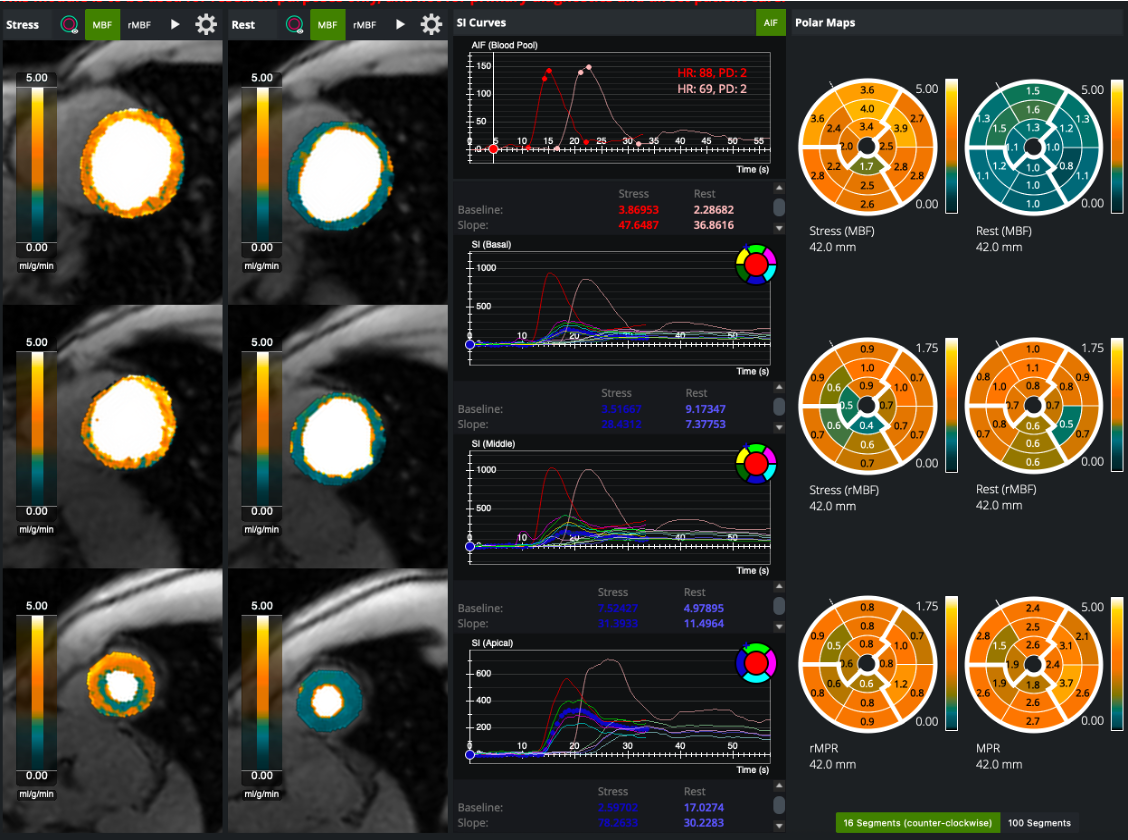
In terms of diagnosis, the review highlighted research that showed automatically generated, fully quantitative CMR MBF pixel maps to have high diagnostic performance for detecting significant CAD. A study of patients with known or suspected CAD revealed that a strong, independent predictor of adverse cardiovascular outcomes was provided by the automatic measurement of reduced MBF and myocardial perfusion reserve using artificial intelligence quantification of CMR perfusion mapping.


Indications for quantitative assessment


The authors believe that the first indication for quantitative assessment in patients with a positive CT, and the second indication in patients with complex coronary artery anatomy, “for whom CT is not a useful examination” - is recommended that functional testing with stress CMR is used for these patients. Quantitative assessment is also used by the authors for the prognostic stratification of patients with heart muscle diseases.


Challenges and conclusion

Among the challenges cited by the review were “a lack of reference values” with “many confounders that can influence MBF thresholds, such as cardiovascular risk factors”. The “cost and lack of availability of perfusion CMR in all centers” were also highlighted.


It is concluded that data suggests “quantitative perfusion could be a solution” to the “puzzle” of CAD diagnosis. The authors propose that now “quantitative perfusion has started to be used in a large number of patients, their data must be entered into large registries that track outcomes,” before artificial intelligence is used to establish “robust MBF thresholds that are related to patient outcomes”.


To learn more about quantitive perfusion and the many benefits it possesses, from high diagnostic accuracy to fast and automatic analysis, why not try it out for 42 days? Download a free cvi42 trial to discover the many capabilities and benefits of a powerful multi-modality imaging software.


Sources:

https://www.emjreviews.com/cardiology/article/clinical-efficiency-of-absolute-quantitative-cardiovascular-magnetic-resonance-myocardial-perfusion-for-coronary-artery-disease-s020321/


https://www.researchgate.net/publication/339462630_Clinical_quantitative_cardiac_imaging_for_the_assessment_of_myocardial_ischaemia


https://pubmed.ncbi.nlm.nih.gov/24357404/


https://pubmed.ncbi.nlm.nih.gov/26642757/


https://jcmr-online.biomedcentral.com/articles/10.1186/s12968-018-0493-4#:~:text=Our%20study%20demonstrates%20that%20the,in%20the%20identification%20of%20CAD.&text=Rest%20images%20did%20not%20significantly,similarly%20to%20level%2D3%20operators


https://pubmed.ncbi.nlm.nih.gov/27894070


https://pubmed.ncbi.nlm.nih.gov/29454767/


https://www.researchgate.net/publication/339273369_The_Prognostic_Significance_of_Quantitative_Myocardial_Perfusion_An_Artificial_Intelligence_Based_Approach_Using_Perfusion_Mapping

Two people talk across a desk in a green-toned office, with a coronary CTA in the background.
May 19, 2026
Part 1 of 5 in Circle's Coronary Plaque series. Consider a familiar scenario. A 52-year-old presents with atypical chest discomfort. The stress test is borderline. The referring physician is uncertain — is this true coronary disease, or something else? Standard imaging has been done. The anatomy looks, on the surface, mostly normal. And yet something about this patient doesn't sit right. This is the case where clinicians have historically had to make consequential decisions with incomplete information. Escalate to invasive angiography and risk an unnecessary procedure. De-escalate and risk missing a vulnerable plaque that hasn't yet caused significant stenosis — but will. Coronary artery disease doesn't announce itself neatly. A substantial share of acute coronary events occur in patients with non-obstructive coronary disease — lesions that would not have triggered revascularization on a standard angiogram. The stenosis grade has always been an imperfect surrogate for risk. What matters is the plaque itself: its composition, its burden, and its vulnerability. Advanced CCTA plaque analysis changes that calculus.
A medical professional in a navy blue scrub top points to heart scan imagery on a monitor while consulting a colleague.
May 12, 2026
The Effort, Risks, and Why It’s Worth It Quantifying the Effort of a Single Platform Learning a new (or deeper) way of working Even for existing cvi 42 users, full standardization across cardiac imaging means: Adapting to new modules or modalities. Rethinking how you structure reading lists when more work is visible in one place. Helping develop shared templates and protocols. It’s completely normal to see a temporary dip in productivity when something new is introduced. Our brains are wired for loss aversion: we tend to focus more on what we might lose than on what we could gain. Recognizing that bias helps put the slowdown in perspective: it’s not a setback, it’s just part of the process that leads to long‑term progress. 
Secure data within the cvi42 cardiovascular imaging application for AI enabled postprocessing
May 5, 2026
Local Processing for Complete Data Security When cvi 42 processes imaging data, everything takes place within the customer’s secure environment. All image data and derived results are managed locally, whether on a hospital workstation or through a customer-managed server installation. No data is ever transmitted outside the institution. This architecture ensures compliance with strict hospital IT policies and data protection frameworks. For clinical users, this means AI-powered results without any compromise to data privacy or network security. The Circle AI Engine: Trained, Validated, and Frozen “Each of the AI models powering cvi42 is architected and developed within Circle’s controlled research and development environment. Circle’s data science and clinical AI research teams use diverse and representational datasets to train and validate each algorithm. The process typically involves supervised learning, where the AI learns to recognize patterns and structures such as the left ventricle, myocardium, or aortic root by comparing its results to expert-annotated data. Once performance meets clinical and regulatory standards, the AI model is locked, “frozen” and encrypted during its integration within cvi42. This means the model’s behavior is fixed, it does not continue to learn or change once deployed at a customer site. The model you use in cvi 42 is the validated version approved for clinical use, ensuring consistent and reproducible results across all installations. No Learning from Customer Data It is important to clarify: the AI in cvi 42 does not learn from any data processed at the customer site. The algorithm applies its pre-trained parameters to each image set locally. It does not store patient data, send information externally, or modify its internal model based on what it sees or whether a user edits its outputs. Each analysis is isolated, ensuring the AI’s decisions remain consistent and the patient’s information stays protected within the facility’s network. How the AI Analyzes Medical Images At a technical level, cvi42’s AI is a deep learning-based image analysis engine trained to recognize and segment cardiac anatomy on MR and CT images. Primarily using convolutional neural networks, it performs pixel- or voxel-level classification to delineate key structures, including the endocardial and epicardial borders. These segmentations enable the measurements of clinically relevant metrics such as chamber volumes, ejection fraction, and myocardial mass. This process mimics how expert readers would interpret the same dataset, but it happens in seconds and with objective consistency across cases. Designed for Trust, Built for Performance AI in cvi 42 is designed to automate routine analysis while keeping clinicians fully in control. Users can review, adjust, and approve AI-generated contours as needed, ensuring that results always meet their clinical standards. Combined with local data processing, frozen AI models, and Circle’s rigorous training pipeline, this approach delivers accuracy and reliability without ever compromising patient privacy.
A healthcare worker in a white coat juggles colorful balls in a hospital corridor, with staff and a patient nearby.
March 23, 2026
Clinical Wins and Daily Practice Introduction A single cardiovascular imaging platform like Circle’s cvi 42 changes daily work for cardiologists and radiologists from “tool juggling” to focused clinical practice. But it also asks for effort and carries real, though manageable, risks. Seeing this change from your perspective, the people interpreting images and shaping programs, makes it easier to decide whether adopting a unified platform is worthwhile.

Subscribe to our newsletter

 Don’t miss future articles or publications.