
Light gray square, with a dark gray border on the sides.

Blog

CCTA Plaque Analysis Is Now a Clinical Expectation. Here's How to Deliver It Without Breaking Your Department.

June 25, 2026

Part 4 of 5 in Circle's Coronary Plaque series. Also read:

Part 1 — How Advanced Plaque Analysis Changes the Clinical Calculus

Part 2 — The IT Infrastructure Behind CCTA Plaque Analysis

Part 3 — The Financial Case for Coronary Plaque Services


It's Monday morning review. Throughput is off target again. Two radiologists are working through a backlog of CCTA studies from Friday. Your most experienced cardiac CT tech just submitted a PTO request for a week in July that you can't cover without asking someone else to come in. And now cardiology has sent a note asking why the plaque analysis reports are taking so long.


This scenario is not unique to your department. It is the operational reality facing most cardiac imaging programs as CCTA volume grows and clinical expectations evolve faster than workflows do.


Coronary plaque analysis has moved from a research capability to a clinical standard — driven by updated ACC/AHA Chest Pain Guidelines, 10-year SCOT-HEART outcomes and the ongoing SCOT-HEART 2 trial, and a growing population of patients and referring physicians who know what to ask for. Meeting that expectation with a manual workflow built for a simpler era of CCTA reporting is not a sustainable operating model.


The question is not whether to offer plaque analysis. The question is how to build the workflow to deliver it without adding to a backlog that's already under pressure.

The Operational Cost of Manual Plaque Analysis


Manual coronary plaque quantification — segmenting the coronary tree, identifying plaque components, scoring high-risk features, and generating a structured report — takes a trained reader 30 to 45 minutes per study when done in a dedicated standalone tool. That time includes data export from PACS, import into the analysis application, manual tracing and review, and results entry back into the reporting system.


For a program doing 15 CCTA studies per week, that translates to 7-11 hours of additional reading time weekly. At the compensation rates typical for cardiologists and radiologists, that is a significant cost. More importantly, it constrains the number of studies the program can complete each day — a direct cap on throughput and revenue capacity.


The workflow friction also affects staff differently than volume metrics capture. According to JACR research on practice resources to address radiologist burnout, administrative and manual processing tasks are among the leading contributors to reader dissatisfaction and burnout. In a tight labor market for cardiac imaging specialists, the quality of the workflow experience is a retention factor — not just an efficiency metric.


What Changes With AI-Assisted Plaque Analysis


AI-assisted plaque quantification in cvi42 changes the time-per-study equation in two ways: it automates the segmentation and measurement steps that consume most of the manual time, and it does so within the same application environment your team already uses for CMR, CT function, and structural heart analysis.


The practical operational impact:


Report turnaround time. Automated plaque segmentation and quantification reduces per-study analysis time from 30-45 minutes to approximately 5-10 minutes of review and approval. For a program doing 15 CCTA studies per week, that recovers 5-8 hours of reader time weekly — time that can be applied to additional studies, CMR reading, or simply keeping up with the day's volume.


Same-day reporting. When analysis is fast and integrated, studies ordered in the morning can be reported the same day. That matters for referring physicians, for patient experience, and for the department's reputation in a competitive referral market.


Workflow consolidation. Because cvi42 handles plaque analysis within the same interface as CMR and structural heart work, readers do not switch between applications. There is no separate login, no data export, no results re-entry. The plaque data is part of the standard report — not an appendix assembled from a separate system.


Consistency across readers. AI-assisted quantification standardizes the measurement approach. The plaque volume, LAP burden, and high-risk feature scores are generated by the same algorithm regardless of which reader or which shift reviews the study. That consistency is important for serial studies — tracking plaque progression in a patient over time requires comparable baseline measurements — and for program quality metrics.


Change Management: Getting Your Team There


Adding a new analytical capability, even a well-designed one, requires deliberate change management. For department heads navigating that process, a few considerations:


Involve readers early. Cardiologists and radiologists who participate in workflow design are significantly more likely to adopt new tools successfully. A brief pilot with willing early adopters — ideally influential readers whose endorsement matters to the rest of the team — creates internal advocates before the formal rollout.


Set realistic throughput expectations during transition. The first two to four weeks after a new tool goes live typically show a temporary throughput dip as readers build familiarity. Planning for that dip — adjusting targets, buffering schedules slightly, providing accessible support — prevents it from becoming a flashpoint.


Anchor the change to clinical value. Staff who understand why the new capability matters — and hear that from clinical champions, not just administration — adapt more readily. The clinical case for plaque analysis (see Part 1 of this series) is genuinely compelling. Share it with your team.


Track the right metrics from day one. Report turnaround time, per-study analysis time, and study volume per reader day are the operational metrics that tell you whether the new workflow is delivering what it should. Establish baselines before go-live and track improvement actively in the first 90 days.


A Different Monday Morning


The operational pressures facing cardiac imaging departments are real. Volume growth, staffing constraints, quality expectations, and the pace of clinical guideline evolution are not going away.

A workflow built on manual analysis in a fragmented set of point solutions will continue to fall behind those pressures.


A unified post-processing platform with native AI-assisted plaque analysis does not eliminate every operational challenge — but it addresses the core ones: it reduces per-study time, standardizes output quality, simplifies the tool environment for staff, and gives the department the throughput capacity to grow.


That's the version of Monday morning review where the numbers are where they should be, the team is functioning well, and the backlog isn't the first thing on the agenda.


See a cvi42 workflow demo for CCTA plaque analysis →


Stay tuned for practical tips to adding Advanced Plaque Analysis to your practice.

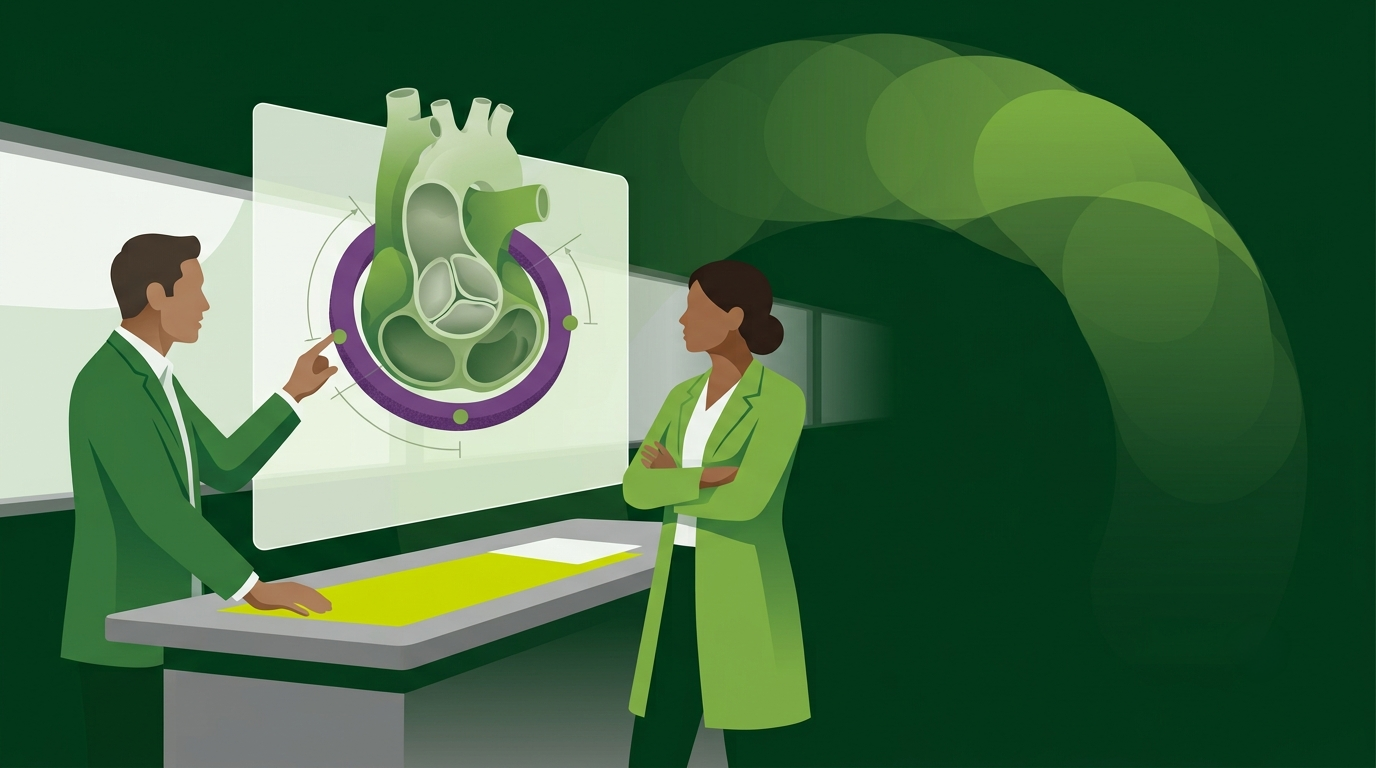
Person in green examines a glowing green sphere beside a white control panel in a green-toned room.
June 16, 2026
Part 3 of 5 in Circle's Coronary Plaque series. Also read: Part 1 — How Advanced Plaque Analysis Changes the Clinical Calculus Part 2 — The IT Infrastructure Behind CCTA Plaque Analysis The cardiology service line is under familiar financial pressure: rising volumes, tighter margins, growing competition from outpatient and independent imaging centers, and a capital environment that demands every major investment justify itself with a clear return. Against that backdrop, coronary plaque analysis has emerged as a meaningful financial opportunity — one with a growing reimbursement pathway, expanding referral demand, and the kind of clinical differentiation that drives patient retention. But the financial case only materializes if the program is set up to deliver the service efficiently and at scale. This is not an investment in a research capability. It is an investment in a billable, guideline-supported clinical service with a documented and growing payer footprint.
June 9, 2026
A landmark study shows that measuring how much an aneurysm sac shrinks in the first year after surgery can reliably forecast what that sac's diameter will do over the long haul — unlocking smarter, more personalised patient monitoring. The Problem with Watching Arteries Heal Abdominal aortic aneurysms — dangerous bulges in the body's main artery — kill tens of thousands of people each year when they rupture without warning. Endovascular aneurysm repair, or EVAR , is a minimally invasive surgery in which doctors thread a stent-graft through the groin to seal off the bulge from the inside, like patching a weak hose from within. It's revolutionised vascular surgery, offering patients a far quicker recovery than open surgery. But EVAR is not a cure. The sealed sac still exists inside the body, and over months and years it can change size — ideally shrinking as blood pressure is removed from it, but sometimes stubbornly staying the same or even growing. A sac that keeps expanding after surgery can signal a dangerous leak (called an endoleak ) or graft failure, either of which may require a second intervention. So, after every EVAR procedure, patients face a lifetime of periodic CT scans to check one simple thing: is the sac getting bigger or smaller? "For years, the number clinicians relied on was a single diameter measurement — essentially, how wide is the bulge? But width alone turns out to be a surprisingly blunt instrument." - Background context from the field of post-EVAR surveillance The challenge is that current guidelines require follow-up CT scans roughly every year for life, which is expensive, exposes patients to radiation, and still may miss subtle warning signs until they have become obvious on a simple diameter measurement. Researchers and clinicians have long wondered: is there a better, earlier signal we could use?
June 2, 2026
Part 2 of 5 in Circle's Coronary Plaque series. Also read: Part 1 — How Advanced Plaque Analysis Changes the Clinical Calculus When clinical cardiology adopts a new capability, IT inherits the infrastructure. And right now, coronary plaque analysis is moving from research tool to clinical standard fast enough that many IT and PACS teams are still catching up. The demand is real. The 2021 ACC/AHA Chest Pain Guidelines made CCTA a Class I recommendation for stable chest pain evaluation. More recent trial data — including 10-year outcomes from SCOT-HEART and the ongoing SCOT-HEART 2 trial — is driving cardiology programs to go further, adding quantitative plaque characterization alongside standard stenosis reporting. That means new software, new data flows, new integrations — and new complexity landing in your environment. How that complexity lands depends almost entirely on the path the department chooses. There are essentially two: a unified platform that performs plaque analysis natively, inside your existing environment — or a send-away service that moves CCTA data out of your network to a vendor cloud, runs the analysis there, and returns a result. Those two paths lead to very different IT outcomes.
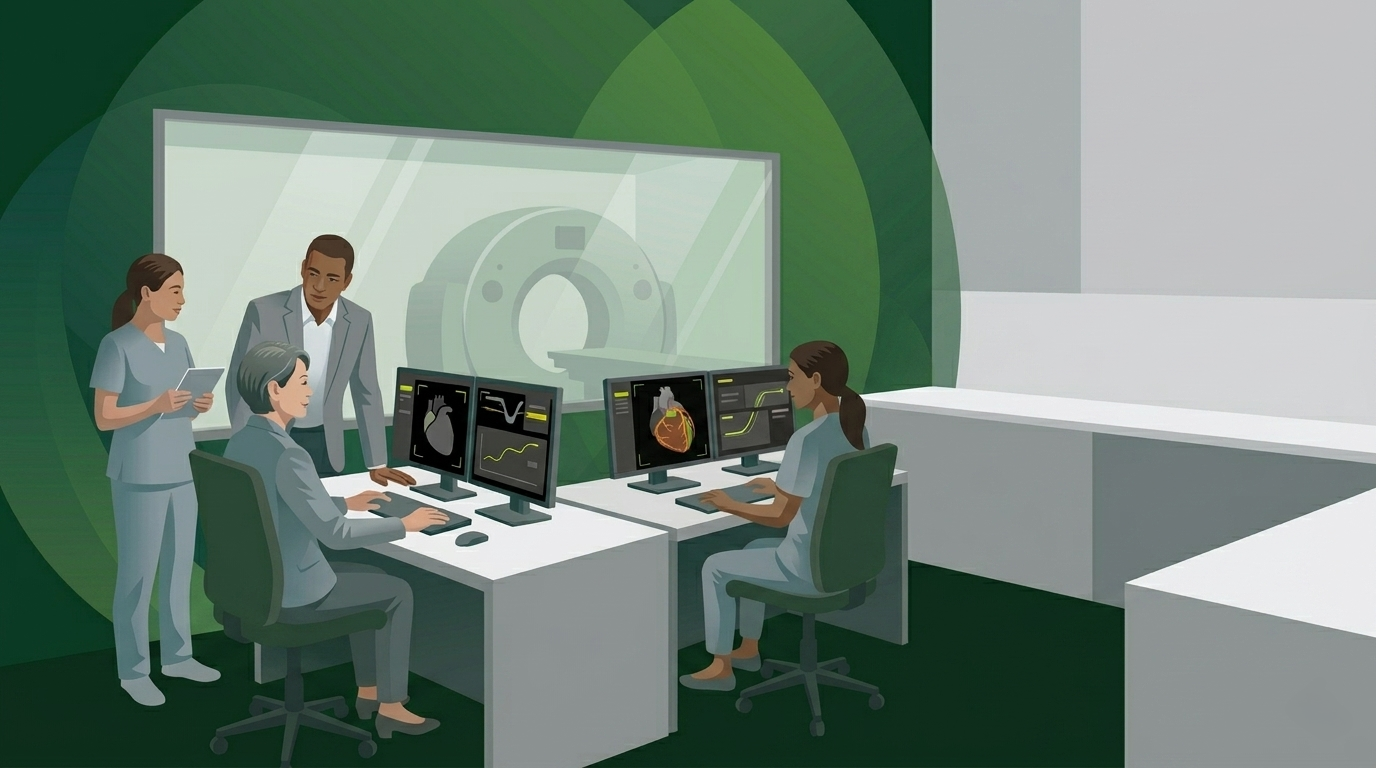
Two people talk across a desk in a green-toned office, with a coronary CTA in the background.
May 19, 2026
Part 1 of 5 in Circle's Coronary Plaque series. Consider a familiar scenario. A 52-year-old presents with atypical chest discomfort. The stress test is borderline. The referring physician is uncertain — is this true coronary disease, or something else? Standard imaging has been done. The anatomy looks, on the surface, mostly normal. And yet something about this patient doesn't sit right. This is the case where clinicians have historically had to make consequential decisions with incomplete information. Escalate to invasive angiography and risk an unnecessary procedure. De-escalate and risk missing a vulnerable plaque that hasn't yet caused significant stenosis — but will. Coronary artery disease doesn't announce itself neatly. A substantial share of acute coronary events occur in patients with non-obstructive coronary disease — lesions that would not have triggered revascularization on a standard angiogram. The stenosis grade has always been an imperfect surrogate for risk. What matters is the plaque itself: its composition, its burden, and its vulnerability. Advanced CCTA plaque analysis changes that calculus.

Subscribe to our newsletter

 Don’t miss future articles or publications.