



Light gray square, with a dark gray border on the sides.

Blog

The Unified Cardiac Workflow: Bridging the Gap Between Anatomy, Function, and Inflammation

March 12, 2026

The Clinical Challenge & the cvi42 Solution


Executive Summary


Cardiovascular disease remains the leading cause of global mortality, yet diagnostic workflows remain fragmented. Traditionally, clinicians have been forced to navigate disconnected systems to assess a patient’s heart: one for anatomy (CCTA), another for function (CMR/Strain), and a third for vascular inflammation (PCAT/Plaque). This "siloed" approach creates diagnostic friction, increases costs, and delays life-saving interventions.

cvi42 by Circle Cardiovascular Imaging disrupts this paradigm. It is the industry’s first unified platform capable of reading Cardiac MRI and Cardiac CT, including AI-enabled Plaque and research-use PCAT analysis, within a single application. By combining Anatomy + Function + Inflammation, cvi42 provides a holistic view of patient health in one seamless workflow.

The Physician Perspective: Precision and Autonomy


For the radiologist and cardiologist, the transition to a unified platform offers three primary advantages:


  1. Elimination of Diagnostic "Blind Spots": Traditional CCTA identifies stenosis (anatomy) but often fails to identify the vulnerability of a lesion. By integrating Plaque Analysis and PCAT (Pericoronary Adipose Tissue), physicians can identify active inflammation—the "hidden" driver of rupture—without leaving the workspace.

  2. Workflow Continuity and Reduced Burnout: Jumping between disconnected systems leads to "swivel-chair" medicine. cvi42 integrates directly into existing PACS and reporting systems (like PowerScribe One) without expensive HL7 interface, allowing for high-throughput analysis that reduces the time from "scan to report".

  3. Financial Sustainability and Reimbursement: With the 2026 transition to a Category I CPT code (75577) for AI-enabled quantitative plaque analysis, hospitals can now retain 70% of the technical and professional reimbursement fee. cvi42 enables the facility to perform these advanced analytics in-house, rather than outsourcing to costly third-party core labs who retain most of the reimbursement.


The Patient Impact & Strategic Outlook


The Patient Perspective: Safety and Certainty


From the patient's point of view, the diagnostic journey is often fraught with anxiety and repetitive testing. A unified workflow changes the experience fundamentally:


  • The "One and Done" Experience: By assessing anatomy, function, and inflammation in a single sitting, patients avoid the "diagnostic odyssey" of stressful weeks spent waiting for multiple follow-up tests.
  • Early Detection of the "Hidden" Risk: Many patients who appear "low risk" on standard CT scans harbor high levels of vascular inflammation. cvi42’s research capabilities—such as the analysis of pericoronary adipose tissue (PCAT) allows researchers to better understand these risks. This work is essential in the shift from reactive surgery to proactive prevention.
  • Personalized Clinical Clarity: A patient is more likely to adhere to a treatment plan (statins, lifestyle changes) when they can see a unified, color-coded map of their own heart's health. cvi42 provides the visual evidence needed to drive patient compliance and trust.


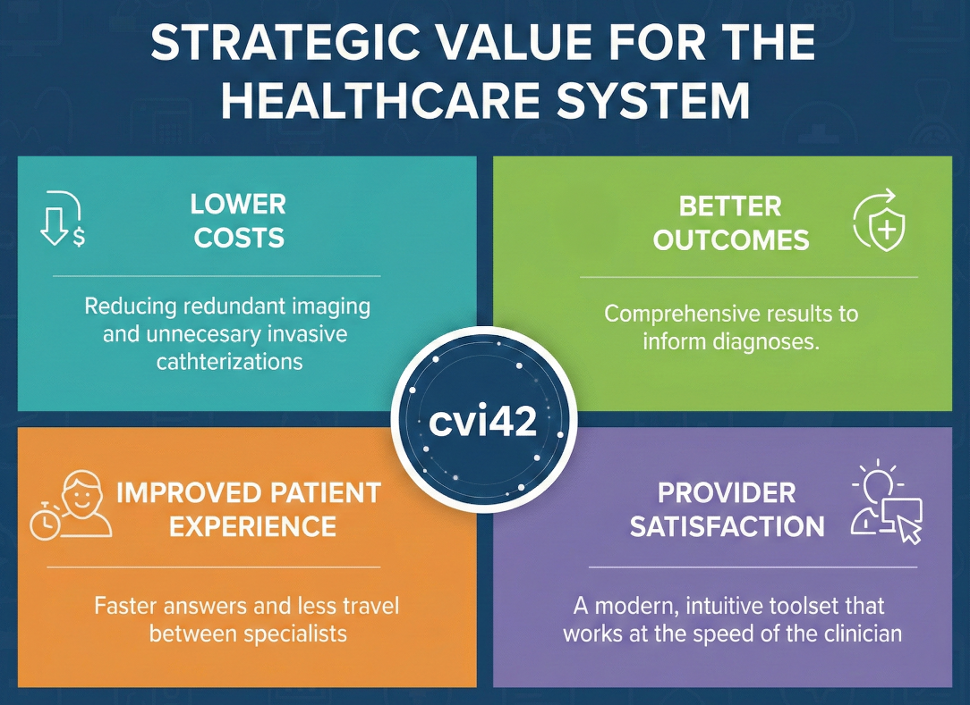
Strategic Value for the Healthcare System


In a value-based care environment, the "All-in-One" approach of cvi42 serves the Quadruple Aim:

1. Lower Costs: Reducing redundant imaging and unnecessary invasive catheterizations.

2. Better Outcomes: Comprehensive results to inform diagnoses.

3. Improved Patient Experience: Faster answers and less travel between specialists.

4. Provider Satisfaction: A modern, intuitive toolset that works at the speed of the clinician.

cvi42 empowers the clinical team to see the whole picture of Anatomy, Function, and Inflammation all in one place. This isn't just a software upgrade; it is a new standard of care for the modern heart center.


Strategic Financial Analysis: The Imaging Department & CFO Perspective


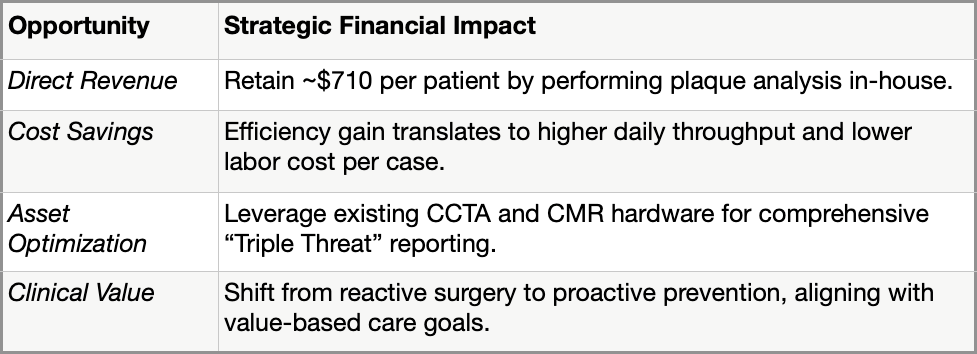
For an imaging department, by consolidating Anatomy, Function, and Inflammation into a single on-premise application, the institution secures immediate financial advantages through new reimbursement streams and significant operational efficiencies.


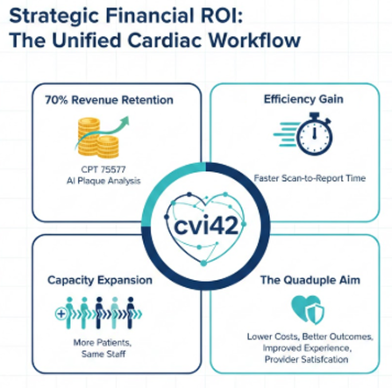
Revenue Capture: The 70% Retention Model


The primary financial catalyst is the 2026 activation of Category I CPT codes for AI-enabled quantitative plaque analysis. While traditional outsourcing models often result in the loss of technical fees to third-party labs, the cvi42 on-premise solution allows the hospital to maintain a commanding share of the revenue.


By keeping these advanced analytics in-house, the facility avoids the high costs of third-party processing, ensuring that approximately 70% of the total reimbursement remains within the hospital's bottom line.


Performance Improvements & Capacity Expansion


The unified workflow directly addresses "swivel-chair" medicine, where clinicians lose productive time navigating disconnected systems.

Reduction in Analysis Time: Integrated reporting and automated AI tools reduce the time from "scan to report".

Expansion of Patient Capacity: The facility can treat more patients without increasing headcount.

Reduced Diagnostic Friction: Reduces the administrative burden of scheduling multiple follow-up tests, further lowering the cost per patient.

Enhanced Provider Retention: Providing a modern, intuitive toolset that works at the "speed of the clinician" mitigates burnout, a major indirect cost for healthcare systems.

Summary of Strategic Financial Value


The future of cardiac care isn't just about faster software; it’s about providing a clearer picture of patient risk when it matters most. By bridging the gap between anatomy, function, and inflammation, cvi42 empowers clinicians to move beyond simple detection toward true prevention. As we transition into this new era of AI-enabled diagnostics and standardized reimbursement, the unified workflow stands as the new gold standard for heart health—transforming complex data into life-saving clinical confidence.

March 10, 2026
Clinical and Financial Wins that Scale From Single Platform to Strategic Advantage Clinicians, department heads, and executives each win differently from consolidation. Circle’s cvi 42 turns integration into tangible impact across MR, CT, structural heart, and electrophysiology programs. Why Circle’s platform stands apart For clinicians: Market-leading MR and CT tools in one workspace, with AI-driven workflows for function, tissue, plaque, and procedural planning—faster, reproducible reads and intuitive tools for edge cases. For department heads: Consistent multimodality workflows, research-grade quantification, and data exports supporting registries and AI projects. For finance leaders: Shared investment across MR and CT service lines, volumealigned pricing, and new reimbursable procedures like AIenabled coronary plaque analysis. 
March 5, 2026
The activation of Category I CPT code 75577 on January 1, 2026, has transformed the reimbursement landscape for AI-enabled coronary plaque analysis, such as Circle Cardiovascular Imaging's FDA-cleared cvi 42 . This FAQ addresses key questions on payers, coverage, coding, payments, opportunities, threats, and value-based care impacts to guide adoption in cardiovascular imaging practices that ultimately lead to commercial viability. For Circle Cardiovascular Imaging customers deploying cvi 42 for plaque analysis, the new CPT 75577 landscape means reliable revenue streams (~$900-1,000 per case) with expanded payer access, but it requires refined billing to navigate bundling and denials. Overall, it accelerates the ROI on cvi 42 by enabling onsite AI processing that captures professional and technical fees hospitals previously outsourced.
February 24, 2026
Why a Unified Cardiovascular Imaging Platform Wins
October 15, 2025
Decoding the Coronaries CAD-RADS, or the Coronary Artery Disease Reporting and Data System, is a standardized reporting system designed to enhance the communication of coronary artery disease (CAD) findings from imaging studies. CAD-RADS represents a significant step towards a more systematic and evidence-based approach to the management of CAD. By standardizing reporting, guiding clinical decisions, facilitating research, and improving risk stratification, CAD-RADS not only holds the potential to improve the clarity of communication between the diagnostician and the downstream physician, but at a larger scale, it could contribute significantly to better cardiovascular health outcomes across populations. 

Subscribe to our newsletter

 Don’t miss future articles or publications.