


Light gray square, with a dark gray border on the sides.

Blog

The Role of CT Plaque Analysis in Clinical Decision-Making

May 26, 2026

In cases where the clinical picture alone is insufficient to guide treatment, CT plaque analysis serves as a powerful tie-breaker — moving the decision from population-level risk estimates to a direct assessment of what is occurring inside an individual patient's arteries.


When results reveal no significant plaque, this provides objective evidence that the patient's arterial health is better than their risk factors alone might suggest. This finding can reasonably support a decision to defer or withhold statin therapy, while offering meaningful reassurance to both the patient and their clinician. 

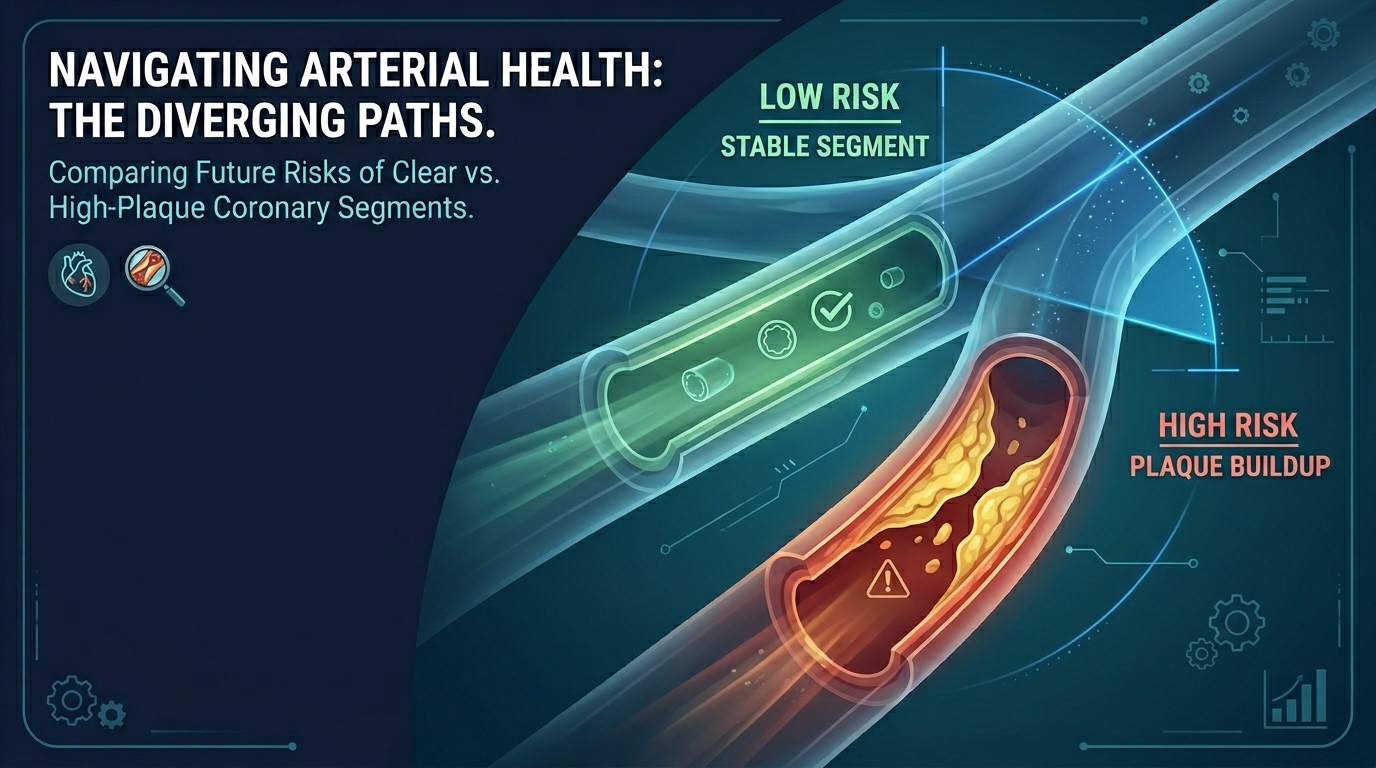
Conversely, when results demonstrate a high plaque burden or high-risk plaque features, this confirms that atherosclerotic disease is already silently progressing — even in the absence of symptoms. Such findings justify initiating or intensifying statin therapy and often prompt a broader, more aggressive approach to cardiovascular risk factor management.

It is within this decision-making framework that the clinical indications for CT plaque analysis are best understood.


CT plaque analysis (typically performed as part of coronary CT angiography (CCTA) with plaque characterization) is indicated in the following clinical scenarios:

Primary Cardiovascular Risk Assessment

  • Patients with intermediate pre-test probability based on their symptoms, age, sex, and risk factors of coronary artery disease (CAD) where risk stratification would change management

  • Asymptomatic patients with an intermediate Atherosclerotic Cardiovascular Disease (ASCVD) risk score (7.5–20%) in whom a treatment decision (e.g., statin initiation) is uncertain. The Atherosclerotic Cardiovascular Disease (ASCVD) Risk Score is a calculation that estimates a patient's 10-year risk of having a major cardiovascular event.

INPUT EXAMPLE
Age & Sex Older age and male sex increase risk
Race Affects baseline risk calculation
Total Cholesterol & LDL Higher = more risk
HDL Cholesterol Lower = more risk
Blood Pressure Higher = more risk
Diabetes Presence increases risk
Smoking Status Current smoker = higher risk
BP Treatment Status Whether on antihypertensives
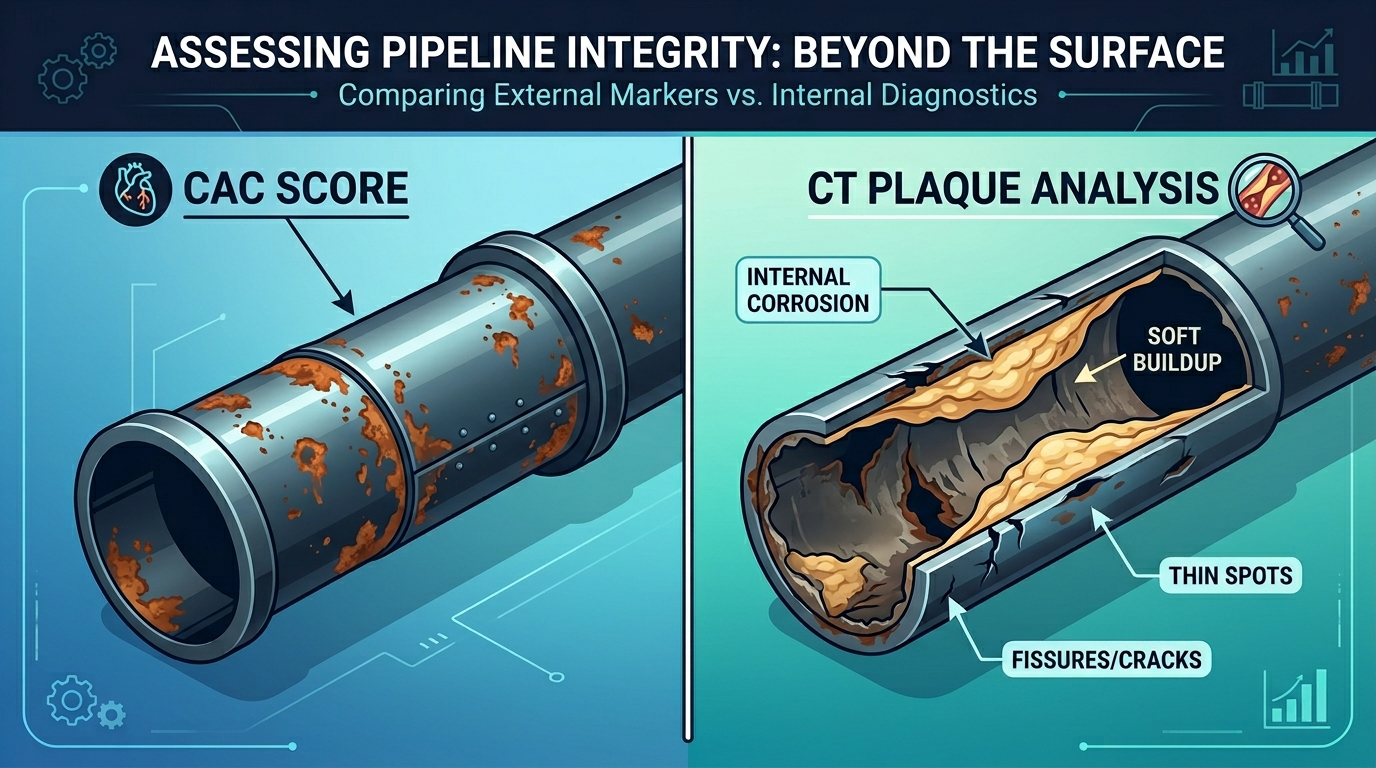
  • Adjunct to or replacement for a coronary artery calcium (CAC) score when more detailed plaque morphology is needed The CAC score only sees calcified plaque — plaque that has already hardened with calcium deposits.


    It completely misses:

    • Soft plaque (lipid-rich, non-calcified plaque)
    • Mixed plaque (partially calcified)
    • Vulnerable/high-risk plaque features that are most likely to rupture and cause a heart attack

This is critically important because:


The plaques most likely to cause a heart attack are often the soft, non-calcified ones — not the hard, calcified ones

Calcified plaque is more stable in many cases. It's the soft, lipid-rich plaques that are prone to rupturing, triggering a clot, and causing an acute myocardial infarction.

Symptomatic Patients

  • Stable chest pain or anginal equivalents with low-to-intermediate pre-test probability of obstructive CAD

  • Atypical chest pain where non-invasive functional testing is inconclusive

  • Dyspnea of unclear etiology where cardiac cause needs to be excluded

High-Risk Plaque Detection


Identifying vulnerable/high-risk plaque features that predict future acute coronary syndrome (ACS), such as:


  • Low-attenuation plaque (lipid-rich necrotic core)
  • Positive remodeling
  • Napkin-ring sign
  • Spotty calcification

Post-Treatment Monitoring

  • Assessing plaque regression or stabilization in response to statin or PCSK9 inhibitor therapy

  • Surveillance in patients with known non-obstructive CAD to track plaque burden progression

Specific Patient Populations

  • Diabetes mellitus with atypical or silent ischemia presentations

  • Chronic kidney disease patients in whom stress testing is limited

  • Young patients with premature atherosclerosis or familial hypercholesterolemia

  • Competitive athletes with exertional symptoms

  • Patients with discordant risk (e.g., elevated LDL but low CAC score, or vice versa)

  • Pre-operative evaluation in selected patients before major non-cardiac surgery

Acute/Urgent Settings

  • Acute chest pain in the emergency department with low-to-intermediate HEART score (as part of the Triple Rule-Out protocol or focused CCTA)

  • Differentiating ACS from non-cardiac causes of chest pain

Contraindications to Consider


CT plaque analysis is generally not indicated in:

  • Patients with known obstructive CAD (invasive coronary angiography preferred)
  • Very high or very low pre-test probability (low diagnostic yield)
  • Severe renal impairment (contrast contraindicated)
  • Significant arrhythmia (poor image quality)
  • Inability to achieve adequate heart rate control

A Simple Analogy


Think of coronary arteries like a pipe:

  • A CAC score is like checking if there is rust (calcium) visible on the outside of the pipe
  • CT plaque analysis is like doing a full internal inspection - checking for rust, soft buildup, weak spots, and areas about to crack


The CAC score tells you something is there. CT plaque analysis tells you what it is, how dangerous it is, and where exactly the risk lies. CT plaque analysis is the step up when you need to truly understand the nature and danger of what is building up inside a patient's coronary arteries.

A PRACTICAL EXAMPLE

A 58-year-old man, no symptoms, has high cholesterol, is borderline hypertensive, and smokes occasionally. His ASCVD score comes back at 14% - intermediate risk.


Should he start a statin?


On paper, it's unclear. But if a CT plaque analysis reveals:


  • Heavyplaque burden with low-attenuation (vulnerable) plaques → Start statin, possibly refer to cardiology
  • No plaque detected → May defer statin, focus on lifestyle, recheck in a tew years

Note: Guidelines from the ACC/AHA, ESC, and SCCT continue to evolve regarding optimal patient selection. Shared decision-making between clinician and patient is central to appropriate ordering, particularly for asymptomatic individuals.

Two people talk across a desk in a green-toned office, with a coronary CTA in the background.
May 19, 2026
Part 1 of 5 in Circle's Coronary Plaque series. Consider a familiar scenario. A 52-year-old presents with atypical chest discomfort. The stress test is borderline. The referring physician is uncertain — is this true coronary disease, or something else? Standard imaging has been done. The anatomy looks, on the surface, mostly normal. And yet something about this patient doesn't sit right. This is the case where clinicians have historically had to make consequential decisions with incomplete information. Escalate to invasive angiography and risk an unnecessary procedure. De-escalate and risk missing a vulnerable plaque that hasn't yet caused significant stenosis — but will. Coronary artery disease doesn't announce itself neatly. A substantial share of acute coronary events occur in patients with non-obstructive coronary disease — lesions that would not have triggered revascularization on a standard angiogram. The stenosis grade has always been an imperfect surrogate for risk. What matters is the plaque itself: its composition, its burden, and its vulnerability. Advanced CCTA plaque analysis changes that calculus.
A medical professional in a navy blue scrub top points to heart scan imagery on a monitor while consulting a colleague.
May 12, 2026
The Effort, Risks, and Why It’s Worth It Quantifying the Effort of a Single Platform Learning a new (or deeper) way of working Even for existing cvi42 users, full standardization across cardiac imaging means: Adapting to new modules or modalities. Rethinking how you structure reading lists when more work is visible in one place. Helping develop shared templates and protocols. It’s completely normal to see a temporary dip in productivity when something new is introduced. Our brains are wired for loss aversion: we tend to focus more on what we might lose than on what we could gain. Recognizing that bias helps put the slowdown in perspective: it’s not a setback, it’s just part of the process that leads to long‑term progress.
Secure data within the cvi42 cardiovascular imaging application for AI enabled postprocessing
May 5, 2026
Local Processing for Complete Data Security When cvi 42 processes imaging data, everything takes place within the customer’s secure environment. All image data and derived results are managed locally, whether on a hospital workstation or through a customer-managed server installation. No data is ever transmitted outside the institution. This architecture ensures compliance with strict hospital IT policies and data protection frameworks. For clinical users, this means AI-powered results without any compromise to data privacy or network security. The Circle AI Engine: Trained, Validated, and Frozen “Each of the AI models powering cvi42 is architected and developed within Circle’s controlled research and development environment. Circle’s data science and clinical AI research teams use diverse and representational datasets to train and validate each algorithm. The process typically involves supervised learning, where the AI learns to recognize patterns and structures such as the left ventricle, myocardium, or aortic root by comparing its results to expert-annotated data. Once performance meets clinical and regulatory standards, the AI model is locked, “frozen” and encrypted during its integration within cvi42. This means the model’s behavior is fixed, it does not continue to learn or change once deployed at a customer site. The model you use in cvi 42 is the validated version approved for clinical use, ensuring consistent and reproducible results across all installations. No Learning from Customer Data It is important to clarify: the AI in cvi 42 does not learn from any data processed at the customer site. The algorithm applies its pre-trained parameters to each image set locally. It does not store patient data, send information externally, or modify its internal model based on what it sees or whether a user edits its outputs. Each analysis is isolated, ensuring the AI’s decisions remain consistent and the patient’s information stays protected within the facility’s network. How the AI Analyzes Medical Images At a technical level, cvi42’s AI is a deep learning-based image analysis engine trained to recognize and segment cardiac anatomy on MR and CT images. Primarily using convolutional neural networks, it performs pixel- or voxel-level classification to delineate key structures, including the endocardial and epicardial borders. These segmentations enable the measurements of clinically relevant metrics such as chamber volumes, ejection fraction, and myocardial mass. This process mimics how expert readers would interpret the same dataset, but it happens in seconds and with objective consistency across cases. Designed for Trust, Built for Performance AI in cvi 42 is designed to automate routine analysis while keeping clinicians fully in control. Users can review, adjust, and approve AI-generated contours as needed, ensuring that results always meet their clinical standards. Combined with local data processing, frozen AI models, and Circle’s rigorous training pipeline, this approach delivers accuracy and reliability without ever compromising patient privacy.
A healthcare worker in a white coat juggles colorful balls in a hospital corridor, with staff and a patient nearby.
March 23, 2026
Clinical Wins and Daily Practice Introduction A single cardiovascular imaging platform like Circle’s cvi42 changes daily work for cardiologists and radiologists from “tool juggling” to focused clinical practice. But it also asks for effort and carries real, though manageable, risks. Seeing this change from your perspective, the people interpreting images and shaping programs, makes it easier to decide whether adopting a unified platform is worthwhile.

Subscribe to our newsletter

 Don’t miss future articles or publications.