

Light gray square, with a dark gray border on the sides.

Blog

Key Questions for New Technologies

March 5, 2026

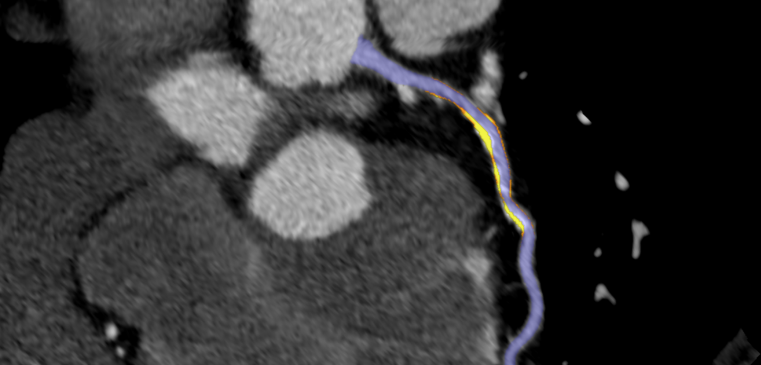
The activation of Category I CPT code 75577 on January 1, 2026, has transformed the reimbursement landscape for AI-enabled coronary plaque analysis, such as Circle Cardiovascular Imaging's FDA-cleared cvi42. This FAQ addresses key questions on payers, coverage, coding, payments, opportunities, threats, and value-based care impacts to guide adoption in cardiovascular imaging practices that ultimately lead to commercial viability.


For Circle Cardiovascular Imaging customers deploying cvi42 for plaque analysis, the new CPT 75577 landscape means reliable revenue streams (~$900-1,000 per case) with expanded payer access, but it requires refined billing to navigate bundling and denials. Overall, it accelerates the ROI on cvi42 by enabling onsite AI processing that captures professional and technical fees hospitals previously outsourced. 


Who is paying for the technology? 

  • New plaque reimbursement codes like CPT 75577 enable Circle CVI's cvi42 for AI-enabled coronary plaque analysis from CCTA, effective January 1, 2026. Payers including Medicare and major insurers like Aetna, UnitedHealthcare, and Cigna now cover this technology. 
  • Medicare pays via OPPS (APC 1511 at ~$951 in hospital outpatient settings) and PFS (~$1,012 national average in physician offices/imaging centers). Commercial payers such as Aetna, Humana, UnitedHealthcare, and Cigna provide coverage, reaching ~70% of insured Americans. Circle CVI's on-premise cvi42 allows sites to retain reimbursement rather than outsourcing. 


Is there coverage already? 

  • Coverage exists through the new Category I CPT code 75577, replacing prior Category III codes (0623T-0626T). Medicare LCDs and billing articles support AI plaque analysis for indications like chest pain with intermediate stenosis. Major commercial policies align, with Aetna issuing immediate coverage post-2026 activation. 


What coding exists? Are there coding gaps? 

  • Primary code: CPT 75577 for quantitative/characterization of coronary plaque from CCTA data, including physician interpretation/report. 
  • Related codes: 75580 (FFR-CT), C9762 (strain MRI). 
  • There are no major gaps noted; Category I status fills the prior temporary code limitations. 


Is payment likely based on existing rates and practices? 

  • Payments follow established rates: $951 OPPS (hospital outpatient), $1,012 PFS (non-facility), based on RUC work RVU 0.85. 
  • Payments are likely stable as this Category I code integrates into standard practices, with CMS recognizing the clinical value. 


What opportunities exist (new CPT codes, NTAP…)? 

  • New CPT 75577 is driving adoption for AI analysis; there is the potential NTAP for inpatient use but has not yet been confirmed for plaque yet and so conducting these exams as an outpatient services should be considered. 
  • This new reimbursement enables Circle cvi42 to scale CCTA workflows, provides for higher CCTA base payments (~$357), and insurer expansions. 
  • The on-premises analysis capabilities boosts site revenue capture without the need for outsourcing, while also providing physicians more control over results. 


What threats exist (bundling, denials, low rates)? 

  • Under the Hospital Outpatient Prospective Payment System (OPPS), CPT 75577 is assigned to APC 1511, packaging the AI plaque service into a bundled payment of approximately $951 rather than as a separate line item. Hospitals receive a fixed rate regardless of additional AI analysis performed alongside CCTA. 
  • Circle cvi42 sites benefit from bundled OPPS payment for CPT 75577, which covers plaque analysis alongside foundational CCTA (CPT 75574). cvi42 enables efficient delivery within this payment, stacking with professional component fees. Hospital outpatient sites bill single APC 1511 claim including both services, paid $950.50 
  • cvi42 integrates AI plaque quantification directly into CCTA protocols: scan with 75574 (APC 5572, ~$357 base), then process onsite for 75577 plaque metrics (fatty/calcified volume, stenosis risk) within APC 1511's resource threshold. This captures comprehensive value in one outpatient encounter, avoiding outsourcing losses. 
  • Physicians bill 75577-26 separately (~$41 RVU) for interpretation/report generated by cvi42. 
  • Add perfusion (78431 APC 1522 ~$2,250) or strain if applicable; cvi42 unifies across MR/CT for multi-procedure sessions under MPFS/OPPS. Elevate subscription scales licensing, turning bundled payments into margin via higher volumes. 


  • Payers require explicit evidence linking plaque analysis to indications like intermediate-risk chest pain or CAD-RADS 1-3 stenosis, per Medicare LCDs and commercial policies. Incomplete reports lacking quantitative plaque metrics (e.g., volume, composition) or physician interpretation trigger ~20-30% denial rates initially, necessitating appeals with structured templates. 
  • Sites using Circle cvi42 can mitigate denial risks by leveraging its built-in AI quantification, interactive controls, and customizable report templates to produce LCD-compliant documentation linking plaque to indications like intermediate-risk chest pain or CAD-RADS 1-3. This ensures explicit evidence of medical necessity with quantitative metrics, slashing initial denial rates from 20-30% to under 5% 


  • Implement pre-billing QC checklists ensuring reports include quantitative plaque metrics, CAD-RADS linkage, and medical necessity (e.g., chest pain with 1-3 stenosis). 
  • Use root-cause analysis on denials dashboards to triage documentation gaps, then standardize reporting templates for LCD compliance. 
  • Secure prior authorizations upfront for commercial payers like Cigna. 
  • Multiple Procedure Payment Reduction (MPPR) cuts reimbursement by 50% for subsequent imaging codes in the same session, potentially dropping 75577 payments below $500 when bundled with CCTA (75574). Productivity adjustments in PFS further erode physician office rates to ~$800-900 nationally. 
  • cvi42 users can mitigate MPPR impacts (50% cut on 75577 TC when following 75574) and PFS productivity adjustments through optimized sequencing, on-premise efficiency, and multi-modality scaling that offsets reductions while maximizing reimbursable volume. This preserves net payments above $500/case despite cuts, leveraging cvi42's workflow speed for higher throughput.


  • Local Coverage Determinations (LCDs) differ by jurisdiction (e.g., stricter Noridian criteria vs. broader Palmetto policies) while commercial payers like Cigna may demand prior authorization despite Category I status. This inconsistency complicates standardization for Circle CVI users scaling plaque workflows. 
  • Circle cvi42 customers mitigate LCD/payer inconsistencies by deploying configurable templates, a centralized compliance matrix, and automated prior auth workflows that standardize documentation across jurisdictions like Noridian (stricter) and Palmetto (broader), while handling Cigna's PA demands. This enables seamless scaling of plaque workflows with <5% variation in approval rates. 


Will value-based care (bundles, ACOs, HMOs) create obstacles or opportunities? 

  • Bundles/ACOs/HMOs pose obstacles via fixed payments that may undervalue add-ons like plaque analysis, encouraging only essential services. 
  • Opportunities arise if plaque analysis demonstrates outcomes (e.g., reduced MACE), justifying inclusion in risk-adjusted models or shared savings. Plaque analysis can be positioned as a preventative tool for CAD-RADS 1-3 to align with value-based care incentives. 


With CPT 75577 now live and payer coverage expanding, Circle’s cvi42 positions clinics to capture reimbursements while advancing precise plaque characterization. Review local payer policies and documentation requirements to maximize these opportunities and mitigate risks in the evolving cardiac CT ecosystem. 

Subscribe to our newsletter

 Don’t miss future articles or publications.