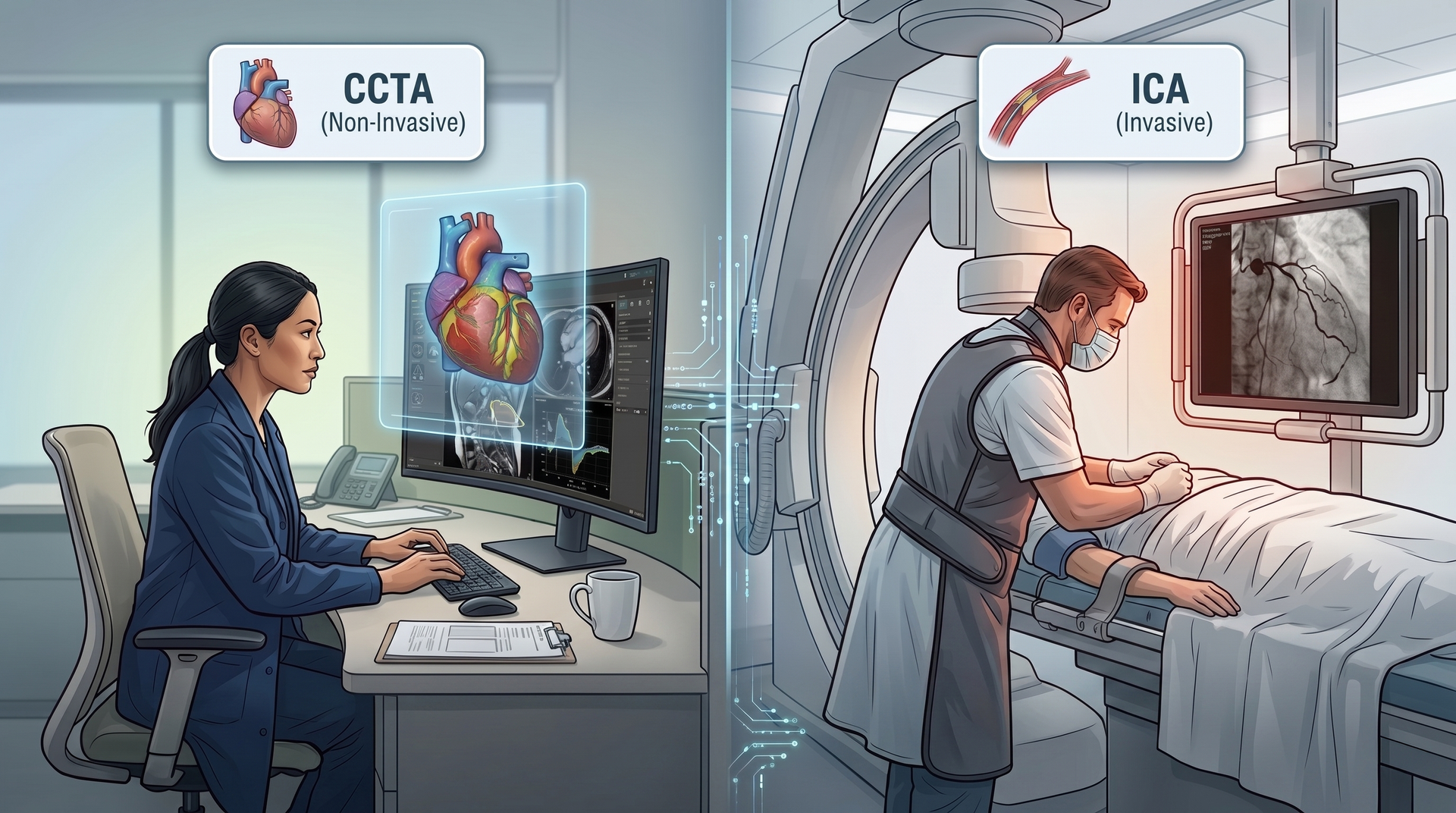
A cardiac computerized tomography (CT) scan – which can also be referred to as a coronary CT angiography or CT angiogram – is an imaging test to view the heart and blood vessels. It is a test that carries few risks and is less invasive than alternative procedures such as an angiogram.
In this article, we are going to compare an angiogram with a cardiac CT scan; a more modern version of the traditional angiogram.
What is an angiogram?
An angiogram uses X-rays to produce images of the heart’s blood vessels. It is done to check for any restrictions of the blood flow to the heart. An angiogram is also able to diagnose and treat conditions relating to the heart and blood vessels.
An angiogram works by guiding a catheter into the artery near the wrist or groin so the contrast dye can be injected to highlight blood vessels within the targeted area. An incision must be made in order to insert the catheter, and this is performed under a local anaesthetic. As the contrast agent flows through the blood vessels, X-rays of the head and chest will be taken from various angles. This is to diagnose or detect any issues affecting a patient’s blood vessels, such as atherosclerosis.
What is a CT angiogram?
A cardiac CT angiogram is a less invasive version of the traditional angiogram. Utilising state of the art computer tomography scanners, it checks the arteries supplying blood to the heart, and can be used to diagnose conditions such as coronary artery disease (CAD). Using detailed images of the heart and blood vessels, a CT angiogram can accurately highlight any narrowed or congested blood vessels.
CT angiography vs angiogram
CT angiography is a less invasive version of the traditional angiogram. The main difference between the two procedures is that while a standard angiogram involves a catheter being inserted into the artery and to the area being studied, a CT angiogram does not require the insertion of a catheter.
A significant advantage of a CT angiogram over a traditional angiogram is that a CT angiogram is non-invasive. However, for cases of abnormal CT angiogram results - such as one or several blood vessels being blocked or narrowed - a standard angiogram may be required as a follow-up. This is typical when surgery to treat the blockage or narrowing is being considered. Therefore, in some cases, a traditional angiogram can be more beneficial than a CT angiogram, as the doctor can perform an angioplasty right away.
How accurate is a CT angiogram compared to a traditional angiogram?
Studies have assessed the accuracy of a CT angiogram in comparison to an invasive coronary angiography. A study of CT coronary angiography vs invasive coronary angiography in coronary heart disease (CHD) looked at data from 44 diagnostic studies using invasive coronary angiography as the reference standard and two diagnostic studies using intracoronary pressure measurement as the reference standard. It was found that compared to invasive coronary angiography, CT coronary angiography had a sensitivity of 80% versus 67%, and a specificity of 67% versus 75%.
It is advised that CT coronary angiography should be the method of choice for ruling out obstructive coronary stenoses (OCS) to avoid patients having to experience an invasive angiogram. However, this should only be advised for patients with a pretest probability for CHD of 50% or lower.
Another study into the accuracy of CT angiography looked at 291 patients with symptoms of coronary artery disease (CAD) who were examined using a 64-slice CT scanner. It was found that CT angiogram identified 85% of patients with significant stenoses and 90% of patients with CAD accurately. The authors concluded that while CT angiography was not ready to replace conventional angiograms entirely, the more modern procedure was nearly as accurate as the traditional angiogram.
Cardiac CT Angiograms possess a high amount of accuracy for detecting CHD in patients when compared to a traditional angiogram. Nevertheless, diagnostic accuracy is decreased in diagnosing coronary stents due and severe coronary artery calcification due to its subordinate spatial resolution when compared to invasive angiograms.
However, a recent discovery has found an ultrahigh-resolution CT scanner that could be capable of overcoming the limitation of conventional CTA in the environment of severe stents or coronary artery calcification, thus surpassing it’s invasive counterpart. The ultrahigh-resolution CT scanner (UHR-CT) is equipped with 0.25 mm detector rows, half the width than what’s currently on the market (0.5 mm), which will result in twice the spatial resolution.
Angiogram risks
As with any procedure that involves X-rays, an angiogram exposes you to radiation. Complications from an angiogram are rare. However, potential risks include:
- Injury to the catheterized artery
- An allergic reaction to the medication or contrast agent
- Arrhythmias
- Bleeding
- Infection
- Stroke
- Heart attack
CT angiogram risks
Like an angiogram, the X-rays that are involved in a CT angiogram will expose you to radiation. The level of exposure will depend on the machine type that is used. There is some degree of risk related to radiation exposure - such as the potential to harm living tissue and cause cancer - although this risk is small. You are not suitable for a CT angiogram if you are pregnant, as there is the potential it might harm your unborn baby.
Other potential complications from a CT angiogram, which are rare, include an allergic reaction to the contrast agent, which could cause symptoms such as:
- Redness
- Itching
- Hives
- Breathing difficulty
- Nausea
Conclusion
A CT angiogram and a traditional angiogram are both effective imaging tests in diagnosing conditions relating to the heart and blood vessels. However, many will favor the non-invasive option of a CT angiogram, which is fast, convenient and relatively painless. A CT angiogram is very accurate in detecting CHD in patients and almost as accurate as a traditional angiogram, allowing doctors to make decisions such as ruling out CAD in patients with a low-to-medium risk of disease.
CT scans are already the preferred method of choice for patients with a pretest probability for CHD of 50% or lower. And with the recent introduction of ultrahigh-resolution CT scanners, it could only be a matter of time until conventional invasive angiograms are slowly filtered out and replaced entirely by CT scanners; due to their accuracy, convenience and development in spatial resolution.
Try cvi42 for CT scanners
Our fully embedded AI medical imaging software tool cvi42, provides unique tools for the evaluations of CAD using cardiac CT. These include:
You can learn more about the capabilities of our leading CT imaging software by downloading a free 42 day trial of cvi42. Experience the difference in AI reporting today. For more information or to speak to our customer support team, please contact us.
Sources:
https://www.ncbi.nlm.nih.gov/pmc/articles/PMC3334923/
https://www.nejm.org/doi/full/10.1056/nejmoa0806576
https://www.docpanel.com/blog/post/significance-coronary-artery-calcification-ct-scan
https://www.nhs.uk/conditions/coronary-angioplasty/
https://www.mayoclinic.org/diseases-conditions/arteriosclerosis-atherosclerosis/symptoms-causes/syc-20350569#:~:text=Atherosclerosis%20is%20the%20buildup%20of,leading%20to%20a%20blood%20clot.
https://www.nhsinform.scot/tests-and-treatments/scans-and-x-rays/angiography#:~:text=An%20angiogram%20is%20a%20type,as%20it%20moves%20through%20them.